
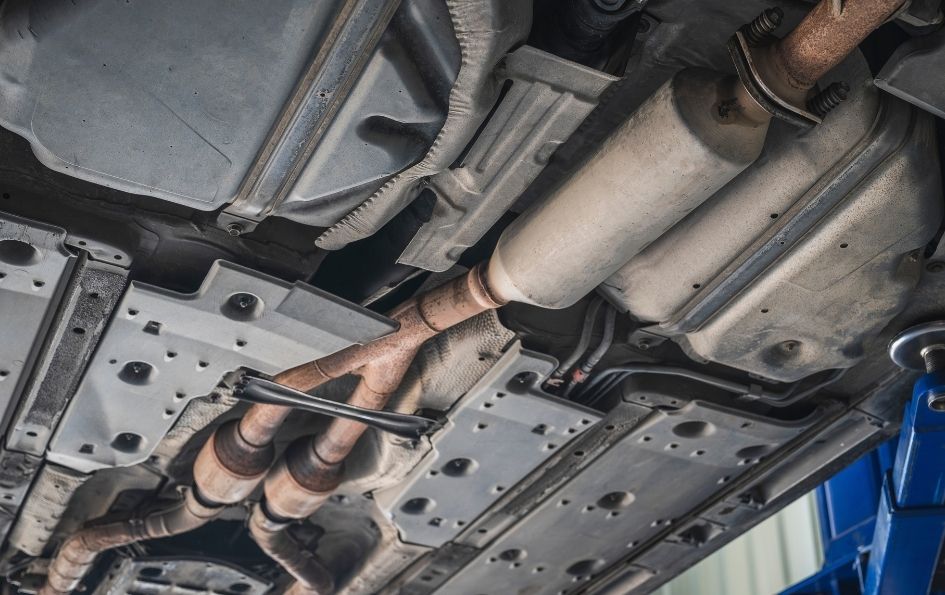
Why Exhaust Flow Controls Engine Power
An engine is an air pump. Every bit of air and fuel that goes in has to come out, and the exhaust system decides how easily that happens. Engineers call the resistance in that path backpressure. Too much of it and the cylinder can’t fully clear itself before the next intake stroke, so the next combustion event starts with leftover exhaust gas instead of fresh air. That shows up as sluggish acceleration, especially when merging or climbing a hill with a load. Drivers often blame the transmission for “not wanting to shift” when the real problem is an engine that can’t breathe.The usual restriction points
- Clogged catalytic converter. The internal honeycomb can break down or melt, partially blocking flow. Symptoms include heat under the floor, a rotten-egg smell, and power that fades the longer you drive.
- Crushed or collapsed pipe. Road debris, a hard speed bump hit, or heavy corrosion can pinch a section closed.
- Failing muffler internals. Baffles rust out and shift, turning the muffler into a restriction instead of a silencer.
What Leaking Exhaust Does to Your Gas Mileage
Modern engines run closed-loop, meaning oxygen sensors in the exhaust tell the computer how much fuel to inject. Those sensors are only accurate if they’re reading real exhaust gas. When a crack, bad gasket, or rusted-through seam lets outside air into the pipe upstream of a sensor, the computer sees extra oxygen and reads it as a lean condition. It responds by adding fuel that the engine never needed. You still drive normally, but you’re buying gas to correct a problem that doesn’t exist inside the cylinder. That’s why an exhaust leak often shows up on your wallet before it shows up on your dash. A quarter-inch pinhole ahead of an oxygen sensor can cost real money over a few thousand miles, and it’ll eventually contaminate or fail the sensor and the converter behind it.Signs your fuel economy loss is exhaust related
- A ticking or puffing sound at cold start that quiets as the metal expands
- Check engine light with lean- or oxygen-sensor-related codes
- A noticeably deeper tone than the vehicle had a year ago
- Soot streaks around a joint, flange, or weld seam under the vehicle
The Safety Side Nobody Wants to Think About
Exhaust gas contains carbon monoxide. It has no smell and no color, and the early symptoms of exposure — headache, drowsiness, mild nausea — look exactly like a long day of driving. That’s the part of exhaust work that isn’t optional. If the leak is ahead of the rear axle, or if the floor pan, trunk seals, or tailgate area have rust openings, exhaust can be drawn into the interior, especially at low speed or with the rear windows down. If you ever smell fumes inside the vehicle or feel unusually tired on a routine drive, get the vehicle inspected before your next trip. Heat is the second safety concern. A restricted converter runs extremely hot and sits inches from carpet, wiring, and fuel lines. Hangers and heat shields matter for the same reason — a dragging pipe or a missing shield puts hot metal against things that shouldn’t be near it.What a Real Exhaust Inspection Covers
A quick look at the tailpipe tells you almost nothing. A useful inspection works front to back.Front-to-back checklist
- Manifold and gaskets. Check for cracks and leaking flanges at the head, where leaks are loudest at cold start.
- Oxygen sensors. Verify they’re reading and responding, not just present.
- Catalytic converter. Compare inlet and outlet temperatures and check for internal rattle.
- Pipes, welds, and flex joints. Look for pinholes, thinning metal, and separated seams.
- Muffler and resonator. Listen for internal rattle and check for waterline rust at the low point.
- Hangers and heat shields. Confirm nothing is loose, sagging, or contacting the body or driveline.
Frequently Asked Questions
Leaks ahead of an oxygen sensor let outside air in, which makes the computer add fuel it doesn’t need. A restricted converter also forces the engine to work harder for the same speed. Both quietly cost you MPG.
Volume alone doesn’t tell you. A ticking sound at cold start usually means a leak near the manifold, while a low drone often points to a rotted muffler or a hole in a rear section. A quick inspection pinpoints it in one visit.
It depends entirely on where it is. Leaks behind the rear axle are mostly a noise and emissions issue, but anything ahead of the cabin can push carbon monoxide inside. If you smell fumes in the vehicle, stop driving it until it’s checked.
A correctly sized system restores the power the engine was designed to make and removes restrictions that were costing you. Expect the vehicle to feel like it did when it was new rather than expecting big peak numbers, unless the system is being built for performance goals.
Once a year is reasonable for most vehicles, and any time you notice a new noise, a fuel smell, a change in fuel economy, or a check engine light. Older vehicles and anything driven on wet or salted roads deserve a closer look.
Get the Noise Diagnosed Before It Costs You a Converter
If your vehicle has gotten louder, lost pep, or started drinking more fuel than it used to, bring it in for a full exhaust inspection. We’ll trace the system from the manifold to the tailpipe, tell you exactly which section is failing, and repair, replace, or fabricate what’s needed.
Contact Kersey Transmission & Exhaust to schedule an exhaust inspection or exhaust service in Warner Robins, GA.


